
Most people who move from semaglutide to tirzepatide stop semaglutide, take no overlapping doses, and start tirzepatide at its lowest dose, 2.5 mg once weekly, under a prescriber’s direction. The Zepbound label gives that 2.5 mg weekly start for 4 weeks and does not recommend taking it with any other GLP-1 receptor agonist. The exact timing of your first tirzepatide dose, and whether you can start higher, is a decision for the clinician who knows your history. This guide explains what is known, what the studies found, and how to prepare so the change goes smoothly.
TL;DR
- Do not take semaglutide and tirzepatide together. The Zepbound label says coadministration with a GLP-1 receptor agonist is not recommended.
- The labeled tirzepatide starting dose is 2.5 mg once weekly for 4 weeks, even if you were on a higher semaglutide dose.
- Evidence on switching is limited and mostly small studies in people with type 2 diabetes, so your prescriber sets the plan.
- Expect stomach side effects to be most noticeable while the dose climbs. Hydration and slow escalation help.
- Bring your semaglutide dose history, last injection date, other medicines and goals to the appointment.
Table of Contents
- Why people consider the switch
- How the switch usually works
- A sample timeline to discuss with your prescriber
- What studies show after switching
- How long until tirzepatide works after the switch?
- Side effects and safety when you switch
- Eligibility and coverage vary by country
- Questions to bring to your prescriber
- Our perspective
- Ready to look at your options?
- FAQ
- Sources
Why people consider the switch
Semaglutide and tirzepatide are both weekly injectables that act on gut hormone pathways involved in appetite, fullness and blood sugar. Semaglutide mimics GLP-1. Tirzepatide mimics GLP-1 and a second hormone, GIP. That dual action is the main reason people ask about moving from one to the other.
Common reasons include:
- Progress has slowed. Weight loss often levels off after the first months, and some people want to see whether a different mechanism restarts it.
- Side effects. Some people find one medicine easier to tolerate than another, and want to talk through options.
- Blood sugar goals. People with type 2 diabetes may need more glycemic control than their current dose delivers.
- Access and coverage. Insurance formularies change, and supply or cost can push a switch.
- Convenience. Some people simply prefer a different dosing ladder or pen.
A switch is a medical decision, not a shortcut. The goal is to move to the option that fits your health, your tolerance and your targets, with a prescriber guiding each step.
How the switch usually works
Stop one, start the other
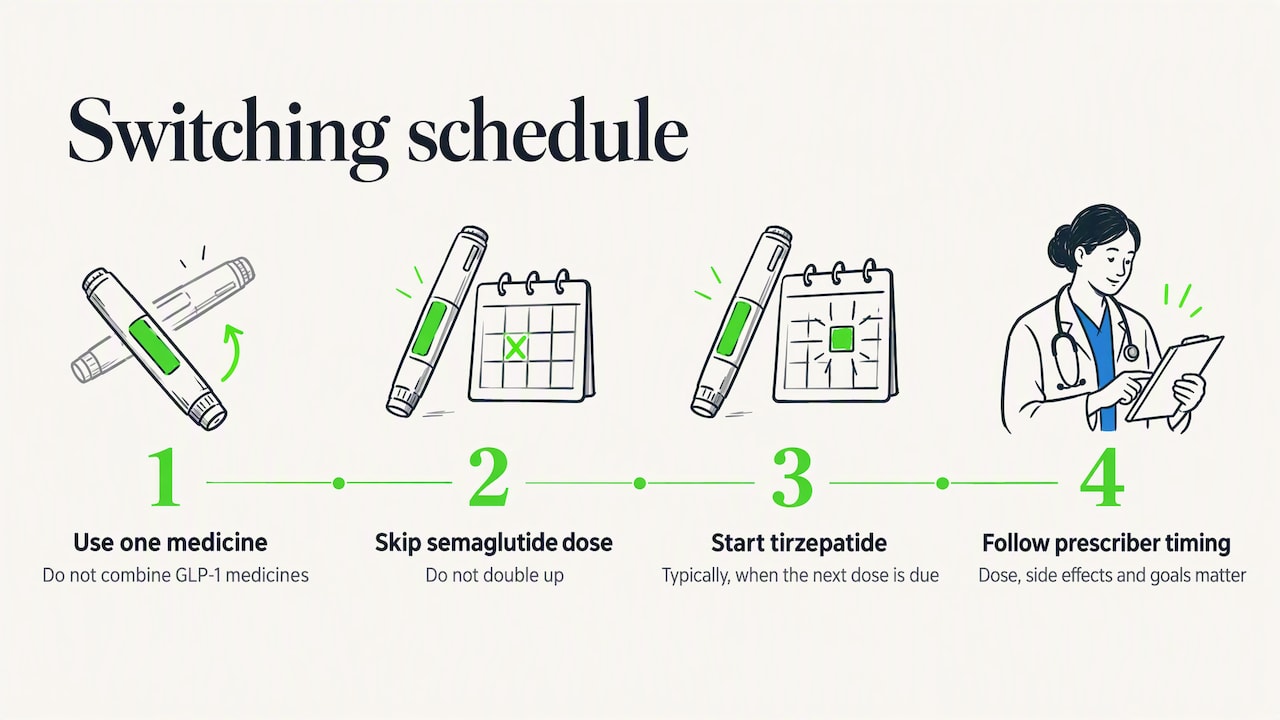
The rule that matters most is simple: you use one medicine at a time. The Zepbound prescribing information states that coadministration with any GLP-1 receptor agonist is not recommended. That includes semaglutide, whatever the brand or dose.
In practice, many clinicians schedule the first tirzepatide injection on the day the next semaglutide dose would have been due. You then skip that semaglutide dose rather than doubling up. Your prescriber may choose a different gap based on your dose, side effects and goals, so follow their instruction over any general rule.
Why there is no single answer on timing
People ask how long to wait, and the honest answer is that the evidence is thin. The NHS Specialist Pharmacy Service notes that evidence for switching between GLP-1 medicines is very limited. It also points out that dose escalations of semaglutide and tirzepatide can take weeks or months to reach steady state, and that delayed gastric emptying may change how oral medicines are absorbed. That last point matters if you take pills such as oral contraceptives, thyroid medicine or anything with a narrow safety margin. Ask your pharmacist whether any of your tablets need extra attention.
The starting dose
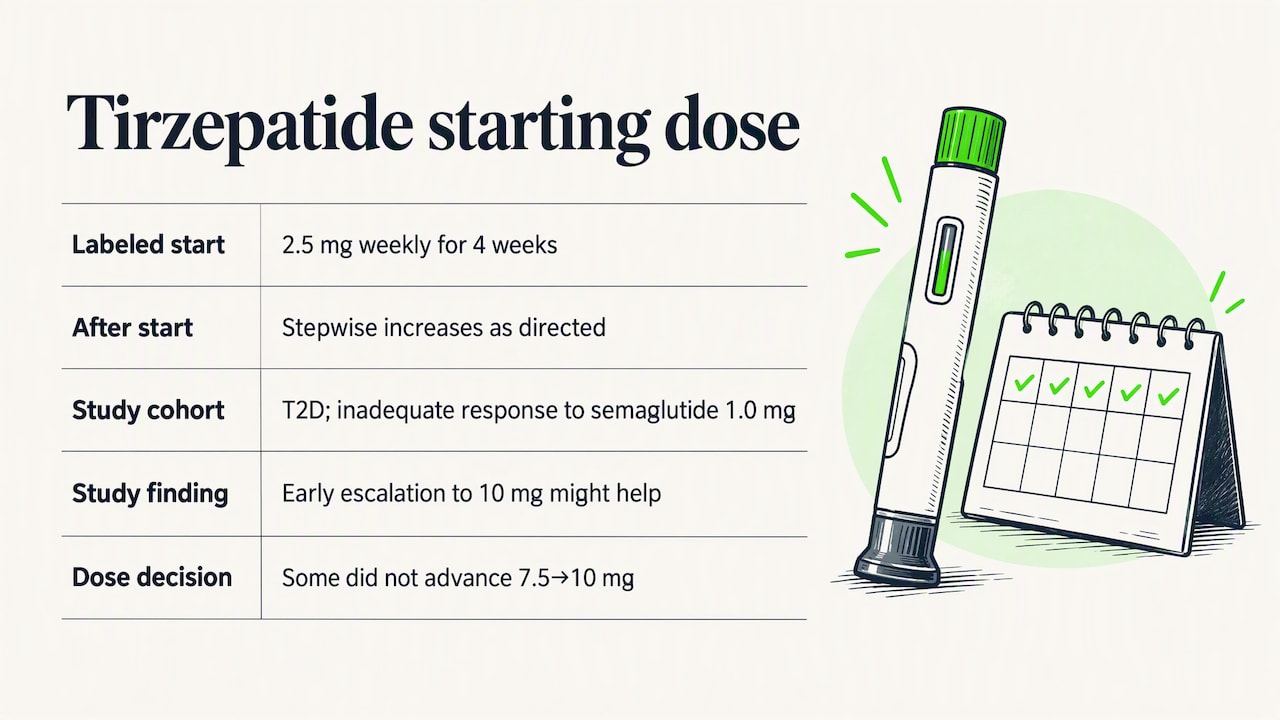
The labeled start for tirzepatide is 2.5 mg once weekly for 4 weeks, followed by stepwise increases as directed. This is a starting dose to let your body adjust, not a judgment on your semaglutide dose. Semaglutide milligrams and tirzepatide milligrams are different molecules, so the numbers are not equivalent. A person on 2.4 mg of semaglutide does not start tirzepatide at 2.4 mg of anything.
Some prescribers move faster through the early steps when a patient tolerated semaglutide well. A 2025 Japanese retrospective study suggested that early escalation to 10 mg might be useful for people with type 2 diabetes who responded inadequately to 1.0 mg of semaglutide. In that same study, some patients did not move from 7.5 mg to 10 mg, based on clinical judgment, past response and patient preference. In other words, even in research, pace was individual.
A sample timeline to discuss with your prescriber
This is an illustration of how a plan can look, not a protocol. Your clinician may set it differently.
| Stage | What typically happens | What to track |
|---|---|---|
| Before the switch | Review semaglutide dose, last injection date, side effects, other medicines | Weight, appetite, any nausea or reflux |
| Switch week | Last semaglutide dose taken or skipped as instructed, first tirzepatide 2.5 mg | Injection day, site, how you feel the first 48 hours |
| Weeks 1 to 4 | Stay on 2.5 mg | Hunger, fullness, stomach symptoms, fluids |
| After week 4 | Prescriber decides whether to step up | Tolerance, weight trend, blood sugar if you monitor |
| Months 2 to 3 | Gradual increases as directed | Progress versus your goals, side effects |
Keep a simple log. Dates, doses, weight once a week, and a note on appetite make your follow-up visits far more productive.
What studies show after switching
It helps to know how limited and how encouraging the data are. Nearly all of it comes from adults with type 2 diabetes, not from people using these medicines only for weight management.
- A 2024 prospective study of 151 adults switched directly from stable GLP-1 therapy, including semaglutide, to tirzepatide 5 mg. By week 12, average HbA1c fell 0.43%, fasting glucose fell 7.83 mg/dL and weight fell 2.15 kg. Stomach events were reported by 13.2%, 2% stopped because of side effects, and there were no severe low blood sugar events or deaths.
- A 2025 retrospective study of 15 people who switched from semaglutide 1.0 mg started everyone on 2.5 mg. After escalation, the group that reached 10 mg had a significant 0.7% HbA1c reduction over 3 months. Weight loss of 6.6 kg was not statistically significant, and differences between groups were not significant either, which is expected with so few participants.
- A 2025 study of 54 adults with type 2 diabetes and fatty liver disease who moved from semaglutide or dulaglutide found significant improvements at 6 months in body weight, HbA1c, fatty liver index, FIB-4 and hsCRP. The authors reported that benefit was still seen in the semaglutide subgroup.
- A modeling study predicted that people switching from semaglutide or dulaglutide to tirzepatide 5, 10 or 15 mg could see HbA1c reductions of 1.95 to 2.46% and weight reductions of 6.50 to 12.1 kg by week 66. These are simulations, not individual promises.
The pattern across these papers is consistent: switching was generally tolerated, and larger changes tended to appear as the dose rose over months. Results differ from person to person, so treat these figures as context rather than a forecast.
How long until tirzepatide works after the switch?
The fair answer is that you may feel appetite changes within the first weeks, while measurable change takes longer. In the 151-person switching study, the 12-week readout showed an HbA1c change of 0.43% and a weight change of 2.15 kg at the 5 mg dose. Because you restart at a low dose and climb, the early weeks are mostly about adjustment. The larger effects in the studies above showed up at 3 to 6 months and beyond, as doses increased.
If you feel little in the first month on 2.5 mg, that does not mean the medicine will not work for you. It is the first rung of the ladder.
Side effects and safety when you switch
A change of medicine means a new round of dose escalation, and that is when stomach symptoms tend to show up. NICE’s practical guide for prescribers, published in March 2025, says tirzepatide’s gastrointestinal effects are common and usually non-serious, are generally more frequent during dose escalation, and can occasionally cause severe dehydration needing hospital care.
Practical steps drawn from that guidance:
- Stay hydrated, especially after vomiting or diarrhea.
- Seek immediate medical help for sudden severe abdominal pain. Tirzepatide should be stopped if pancreatitis is suspected and not restarted if it is confirmed.
- Tell your healthcare team before any surgery.
- Do not use tirzepatide in pregnancy. NICE does not recommend it. If you are planning a pregnancy, talk with your prescriber before you switch.
Also call your prescriber if you cannot keep fluids down, if you are on insulin or a sulfonylurea and notice low blood sugar symptoms, or if you take oral medicines where absorption matters. Your clinician can adjust other treatments as your weight and glucose change.
Note that NICE is a UK body. Dosing labels and eligibility rules differ by country, so follow the guidance from the prescriber and regulator where you live.
Eligibility and coverage vary by country
What you can be prescribed, and who pays, depends on where you live. In the UK, for example, semaglutide for obesity is limited to specialist weight-management services under set criteria, and UK guidance for type 2 diabetes says GLP-1 therapy should continue only if HbA1c falls by at least 11 mmol/mol (1.0%) and weight by at least 3% in six months. In the US, the Zepbound label above is the starting point, and your insurer’s formulary decides coverage. If cost or coverage is behind your switch, ask your prescriber and pharmacist how the new medicine is handled before you stop the old one, so you do not end up with a gap in treatment.
Questions to bring to your prescriber
A short list makes the visit efficient:
- What was my last semaglutide dose, and on which date?
- On which day should my first tirzepatide injection be?
- Do I start at 2.5 mg, or is there a reason to adjust?
- How often will we review the dose, and what will we look at?
- Do any of my other medicines need monitoring during the change?
- What side effects should make me call you the same day?
Our perspective
We hear from people every day who are not starting from zero. They have already done the hard part: they began a GLP-1 medicine, built a routine, and learned how their body responds. When they ask about tirzepatide, they are not chasing a trend. They want to keep moving toward a goal.
Our view is that a switch works best when it is calm and planned. Take one medicine at a time, restart at the labeled low dose, and give each step its full four weeks before judging. The dual-hormone design of tirzepatide is why so many people look at it when progress slows, and the early switching studies show the move is generally well tolerated when it is done with medical guidance.
That is why we focus on a clear product range, secure payment, free worldwide shipping, easy returns and order tracking. You should be able to spend your energy on your plan, not on logistics. Keep your prescriber in the loop, keep a simple log, and shop with confidence.
Terry
Ready to look at your options?
If you and your prescriber have decided that tirzepatide fits your plan, you can browse our Zepbound page to see what we carry. We offer secure payments, free worldwide shipping, easy returns and order tracking, so ordering is simple once your plan is set.

You can also explore the full range on the Medcare Supply home page, including our weight loss medications and peptide categories.
FAQ
What happens if I switch from semaglutide to tirzepatide?
You stop semaglutide and begin tirzepatide at 2.5 mg once weekly for 4 weeks, then increase as your prescriber directs. The two should not be taken together, since the Zepbound label does not recommend coadministration with a GLP-1 receptor agonist. Expect your appetite and stomach to adjust during the first weeks.
How long do I wait between the last semaglutide dose and the first tirzepatide dose?
There is no single proven gap, and the NHS Specialist Pharmacy Service describes the evidence as very limited. Many clinicians start tirzepatide when the next weekly semaglutide dose would have been due. Your prescriber will set the timing for you.
Can I switch from 2.5 mg of semaglutide to tirzepatide?
Yes, with a prescriber’s guidance. The labeled tirzepatide start is 2.5 mg weekly for 4 weeks, whichever semaglutide dose you were on. The milligram numbers of the two medicines are not equivalent.
How long does tirzepatide take to work after switching?
You may notice appetite changes in the first weeks, but larger changes build over months as the dose rises. In a 2024 study of 151 adults, average weight fell 2.15 kg by week 12 after switching to 5 mg. Individual results vary.
Sources
- Zepbound prescribing information (FDA label)
- NHS Specialist Pharmacy Service: considerations and interactions with GLP-1 receptor agonists
- Early dose escalation of tirzepatide after switching from semaglutide (PMC)
- Early dose escalation of tirzepatide after switching, 2025 retrospective study (PubMed)
- Switching to tirzepatide 5 mg from GLP-1 therapy (PubMed)
- Tirzepatide in type 2 diabetes with fatty liver disease (PubMed)
- Model-based simulation of glycaemic effect and body weight (Europe PMC)
- NICE practical guide to using medicines for overweight and obesity
- HTA and reimbursement of anti-obesity drugs across European countries (ISPOR)
- Norfolk and Waveney Formulary: GLP-1 mimetic therapy